Each Passing Moment

I’m feeling particularly philosophical tonight for some reason. And, with thoughts swirling in my head from an accumulation of a week’s worth of circumstances, experiences and overheard conversations, one phrase continues to surface in my brain:

Each passing moment is an opportunity to change.

So what if you’ve made some bad decisions? So what if you haven’t accomplished what you wanted? So what if you never had the courage to say what you wanted to say? So what if you aren’t what you wanted to be? Every passing moment is an opportunity to change. You can alter your fate right now. Make up your mind. Don’t get swept away with the history of yourself. You are in charge. Make up your mind now to take the very next opportunity to define yourself. 

That opportunity is now. Don’t let another minute pass you by.

Comments (2) »

Twitter Sinners

I know… “Another post about Twitter? I’m sick of it!” 

Sorry, but folks are still so blatantly abusing Twitter, I’m forced back on my platform to expose the heathens. Twitter is not a new advertising platform. It’s not a new place for SPAM. I don’t know how many times I have to repeat this VERY SIMPLE law of most all social media: treat it like a real relationship. Right now, you’re not treating Twitter right. You’re abusing it – and that makes you a Twitter Sinner. I’m here to save your soul.

1. Social Media is not about collecting friends. How many friends do you have in real life? I need an exact number. You don’t know, do you? Why not? Because you don’t collect friends. That’s not how friendship, or any relationship, works. So, why do people think that social media is about collecting friends? Do not obsess about how many friends or followers you have. You’re not a better person if you have more followers. 70,000 – oh my! There is no direct correlation between followers/friends and your worth. Deal with it!

2. Give value to your relationship. Any good relationship is symbiotic – you give to me, I give to you. Too often, Twitter relationship are parasitic – one party consumes and doesn’t give back. These are the worst Twitter sinners. Are your messages purely promotional? Or do you offer value to the relationship you’ve created? Do you share articles, insights, breaking news, anything of value? No, telling people you can make them a millionaire is not a post of value. It’s a selfish, promotional tweet.

3. Content before followers. You should post a dozen updates (arbitrary number) with some sort of value before you start hunting for relationships (followers). You’re disgusting, following 800 people with 4 updates. If you want to have a relationship with me, I want to know it will be worthwhile. This is also a rule about giving value to your relationships. 

4. Be upfront with who you are. Are you a company that will be posting promotions, sneak peaks, extras, etc? Are you a person, who will sprinkle tweets with updates about your personal life? It doesn’t matter what you are, I just need to know. I need to know what kind of relationship I’m getting into here. 

5. Do more than re-tweet. Look at your stream of updates – how often are you beginning it with “RT” (ReTweet)? You’re just an aggregator. Have an opinion. Generate your own stuff. Sometimes it’s nice to have somebody passing info along from multiple sources – so I understand if my position on this is controversial, but you’re asking me to have a relationship with YOU. You are the guy at the party, who, when asked his opinion on a matter, quotes somebody else. You’re Matt Damon‘s character on Good Will Hunting. And nobody likes Matt Damon. (OK, just kidding. That was a cheap shot at Damon). 

Here’s a few Twitter Sinners I’ve collected just today. Repent, and change your ways…

Comments (10) »

10 Tips for Being a Better Presenter

Seth Godin Presentation - photo via Flickr/Erik Charlton

Seth Godin Presentation - photo via Flickr/Erik Charlton

I have been giving a lot of presentations (on new media) in the past year or two, and have also been at numerous summits, expos, conventions, etc and sat through presentations – both good and bad. I’ve learned some things along the way about being a better presenter. Am I a perfect presenter? No. I probably even violate my own rules from time to time. But, presenting is about practicing and getting better. This isn’t the list to end all lists, either. I encourage you to add your own best tips to this list. What’s tip #11?

1. Know Your Material. OK, this one is not up for negotiation. You have most likely been asked to speak because you are considered an authority on a particular subject. Or, perhaps you’ve been asked to make a keynote speech or present an award. It is obvious when you don’t know your stuff. Try not to use notes. Being prepared and presenting in a conversational way is going to make a huge difference. I’ve found that presenting actually forces you to know your material better, and forces you to do some additional research. This also allows you to speak with conviction. The best presenters I’ve seen speak with conviction.

2. Limit Words on Your Slides. God, there are some dull PowerPoint presentations! Words only make them worse. I’ve learned from BrainRules, that humans are rules by sight. Words do not excite sight. Images do, and they help us remember content better. According to BrainRules, you’ll remember 10% of what you hear. Add a picture, and you’ll remember 65% of it. “But, I can see the text on the bullet points.” Wrong, bozo! You retain double with images that you retain with text alone. You know who does a great job of using images in his presentation? Seth Godin. He’s incredible. I watched his presentation for Tribes, and I don’t know that he used a single word – all images. And this was a long presentation – but I was engaged the entire time! 

3. Freshen Things Up Every 10 Minutes. OK, I learned this one from BrainRules, too. Apparently, the human brain has an attention span of about 10 minutes (some could make a case for fewer). If you have a presentation that is longer than 10 minutes, you need to tell a relevant story, show a relevant video, or do a relevant activity. Don’t screw with the rules of the brain. They’re pretty concrete. 

4. Harness Your Energy. Because it’s distracting. Many people have anxiety or nervous energy, or even excitement when presenting. That energy has to go somewhere. Often, it comes out in fidgeting or pacing. When you present, take everything out of your pockets – coins, cell phone, shrunken heads, etc. If you don’t you will, without realizing it, fidget with them and the audience will look at nothing but you toying with things in your pocket (this is not what you want!). A lot of people like to pace around when they present – they think it gives the presentation energy. Wrong! It’s distracting. Movement can be strong in a presentation, though, and sometimes there is strength in approaching a person in the audience or referencing a visual aid. However, I gained a tip years ago that if you feet are moving, your mouth shouldn’t be. Skeptical? Try it – it works well. Otherwise, people will watch you pace back and forth and not hear a word you say.

5. Nix the Verbal Ticks. Um, er, uh, you know, such as. These are examples of verbal ticks. They’re those little filler words we mutter when our brain is taking a breath. But, like pacing, verbal ticks can be extremely distracting. Often times, when I notice a presenter is “umming” or “ahhing” I get so obsessed with predicting the next “um” that I can’t pay attention to what is being presented. Not too long ago, I actually starting tallying “ums” and got to about 100 in about 15 minutes. Sad thing is, I don’t think the presenter knew she was leaning on verbal ticks so much. So, record your next speech, or have a friend in the audience critique you (including looking out for your verbal ticks) and see if you are a victim of subconscious verbal ticks. They’re deadly.

6. Know Your Audience. Truthfully, this is probably one of the more important tips for presenters. If you don’t know about your audience, you don’t know what they want to learn about, what they’ll respond to, what jargon they will or won’t understand, what’s offensive to them or what’s important to them. If your contact can’t give you information about the audience as you’re preparing your presentation, just get as much info as you can and resolve to take a straw poll of your audience before you begin. If you’ve obeyed the rules of knowing your material and using more images than text, you can adjust your presentation on the fly and rock it hard. t also helps to meet some of the audience members ahead of time and chat with them. Ask them questions that will lead them to tell stories about experiences that you may be able to reference during your presentation as a segue or a great example. It’s super-strong to be able to say, “Karen and I were talking before we got started, and she mentioned her frustration with ___.” Of course, be aware of anything that may be too private.

7. Have Sticky Eyes. This isn’t as weird as it sounds. It’s about eye contact. Some presenters scan the room non-stop as they present, never landing on a person. Some presenters gaze into their laptop screen or stare at the projector screen. Some just stare at the back wall of the room. This is keeping you from connecting with the people you’re presenting to (oh yeah, those peeps). Make eye contact and maintain it for about three seconds. When moving on to the next person, imagine that your eye-contact is stuck and you can only separate it as though you were stuck with glue. This prevents you from the typewriter-style, shifty eye-movement from one person to the other. Sticky eyes translates as more genuine eye contact and makes them feel like you’re talking to them – it keeps them engaged. 

8. Don’t Hand Stuff Out. People will look at whatever you give them and will not listen to you. If you do want to give people handouts, tell them that you’ll provide a handout with more information after the presentation. 

9. Don’t Turn Off the Lights. OMG – major offenders. Remember in high school when the substitute teacher would turn off the lights and turn on a movie? You’d put your head down and fall asleep. Same thing happens now. People will fall asleep if you turn off the lights. Guarantee it. If you need to, dim the lights near your presentation, but don’t ever turn the lights off. Adjust your visuals if they can’t be seen in a lighter setting. 

10. Scope It Out. Know where you’re presenting, and request to check it out ahead of time. Know how big the stage is, whether you’ll have a podium or not. Know what kinds of tech hookups you have. Do you have outlets, a projector, a screen, speakers? Are you bringing the presentation on a disc, on a jump drive? Are they compatible with the equipment in the room? Hook up any equipment you’ll be using to present and do a dry run to ensure everything works well.  

Above all else – and I’m not assigning this an official number – be a likable person. If the audience doesn’t like you, they won’t listen to you. Be a person. Use voice inflection, use facial expressions, show excitement and emotion. It’s OK to be a person.

PLEASE add to this list so that I (and my readers) can become better presenters.

Comments (8) »

Geico, Who Are You?

Geico‘s marketing efforts are confusing me. They’re really inconsistent. What’s the campaign? Is it the lizard? Is it the caveman? Is it the celebrity testimonial? Oh, maybe it’s the stack of money with the googly eyes. Er, perhaps it’s one of these motorcycle or ATV ads that have nothing to do with any of the others. Remember the, “I’ve got good news… I just saved a ton of money by switching to Geico?” 

Seriously, there seems to be a group of people sitting around a table and coming up with good ideas, and nobody to say, “no, let’s try to be consistent in our marketing efforts.” Instead, they just picked all the ideas, and said, “go with it.” 

Beside the logo slate at the end of a TV spot, I can’t tell that I’m watching a Geico spot. Sure, they’re all kind of quirky, and that is part of their brand, but they’re all so different that they don’t feel related. They don’t feel like a campaign. There are 10 different ideas, 10 different campaigns on the air. Here’s the tragedy in it all – Geico has done of good job of creating strong brand awareness, thanks to the gecko ads that started running in 1999/2000. If you recall, the (now famous) gecko pleaded with people to stop mistakenly calling him to save money on auto insurance. I’ll give Geico credit – they have a strong brand awareness. That’s why it’s tragic…

Why not use this awareness more to your advantage? I feel like with some consistency in marketing, you could leverage that recognition even further. But, until then, I’ll just be confused as to how a lizard, a caveman, squirrels, Joan Rivers, cash with a piercing stare, a baseball coach, a man on a beach with his motorcycle, and a bodyguard are a part of a cohesive ad campaign.

Here’s a list of links to some of the spots I mentioned. I figured links instead of embedding videos, to cut down on loading time.

Lizard – “Free Pie and Chips”

All Caveman Commercials

Squirrels

Joan Rivers Celebrity Testimonial

Googly-Eyed Cash

Motorcycle on the Beach

Female Bodybuilder

Secret Agent

Comments (4) »

Daily Show Realizes Twitter’s Awesomeness

Been meaning to get this posted after seeing it a while back. Some of you may have already seen it, but I think it’s worth sharing. It’s hilarious. If you don’t think so, you’re too tightly wound. It’s The Daily Show‘s take on the Twitter phenomenon. 

LINK TO VIDEO (couldn’t get the video to embed on WordPress for some reason)

Leave a comment »

New Media 101

Here’s the link to my presentation from the Nevada Interactive Media Summit today. Thanks for all of you who attended – please let me know how you liked it. I hope you learned a lot.

New Media 101

Comments (1) »

More Advertising, Please

I am SO sick of companies thinking that if they give you a taste of content that they’re entitled to blast you with tons of worthless, one-way advertising. Disgusting.

A few times a week, I have to endure receiving the “Neighborhoods” version of the Reno Gazette-Journal in the mail. There are a lot of problems with this publication, despite it not delivering on its promise of news in my area of town. This publication is nothing more than a shell for advertising. In this latest issue, it contained 3 pages of content/articles (and 2 of those three pages contained some advertising), and 214 pages of advertising. I’ll repeat those stats – 3 pages of articles, 214 pages of advertising!!! That’s almost 99% advertising. I know, you’re wondering how the hell that’s possible. I must have my numbers wrong. Nope – I counted three times (I’m careful, plus I often waste my time if I can make a point).

RGJ Neighborhoods

RGJ Neighborhoods

99% Ads

99% Ads

Of the flood of ads I received in my newspaper, how many were relevant to me? Who knows? I don’t. I typically throw this whole package away because I know that I am not getting any relevant content in that publication. Advertisers – you are wasting your money! 

It’s no surprise to see that consumers are growing increasingly weary of this kind of “interruption advertising” and turn to communication channels in which they can better control the interaction. Yes, I’m talking about everybody’s favorite hot topic – social media. Sadly, advertisers are already in full stride toward the gold rush that is social media, and treating it the same way they’ve abused mass media. This parasitic behavior makes me ill and angry all at once. Some advertisers are  slithering their way into the established communities in different social media channels, and treating it like their own “Neighborhoods.” Are they giving members of their communities valuable content, meaningful conversation or a symbiotic relationship? Nope. They treat it as a new place to put their ads (and advertisements take many forms). I am warning advertisers again, that you should treat social media like this only if you want to fail. 

You think you’re participating in social media? Re-examine that notion – because if you’re not “playing by the new rules,” you will fail. Have you created a blog and are simply posting your press releases there? Fail. Maybe you created a Facebook page – but is there any community interaction other than you blasting out promotional messages? Fail. Maybe you have a Twitter account so that you can syndicate your blog entries of your press releases. Fail. Are your YouTube videos nothing more than advertisements (be honest)? Fail. I encourage diversification of your presence in social media – but you have to think differently in this arena. It’s not another advertising platform. It’s a community-based form of communication. If I invited you over to my house for dinner, and all you talked about was how Cinnamon Toast Crunch was $2.95, or that your new pickup truck had 250 horsepower or some other way I should come spend money with you… I would never invite you over ever again. Please understand the analogy here.

So – anybody who is putting out content – be it in publications or in social media – evaluate your communications. How much of it is promotional? Don’t let it be 99%. Not even close.

Comments (5) »

This is Why You’re Fat

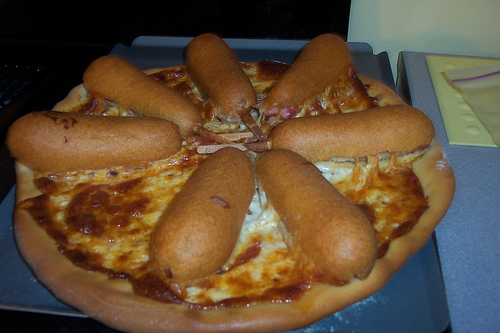
Corndog Pizza (thisiswhyyourefat.com via flickr)

Corndog Pizza (thisiswhyyourefat.com via flickr)

I came across this outstanding blog called This is Why You’re Fat, which asks people to submit photos of food they find that is just blatantly unhealthy. I’ll admit, some of the food on this blog made me really hungry (like the 60-pound Rice Krispy Treat, or the Corndog Pizza). Most of the foods included bacon (Wolfy, there’s a lot of new recipes for you to try).

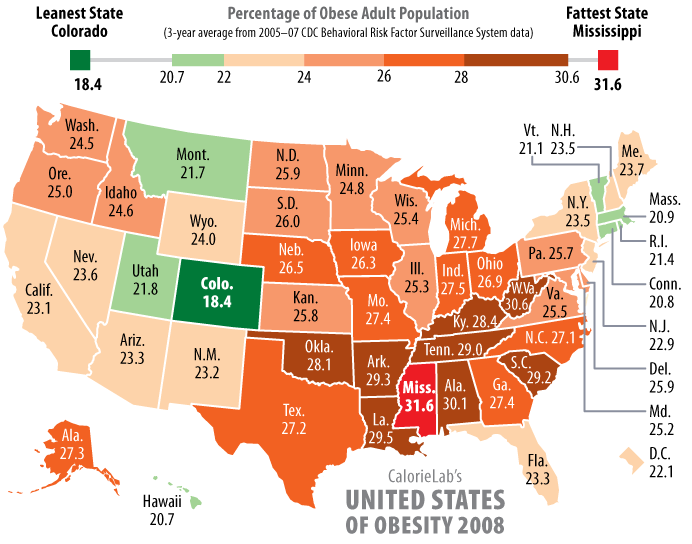
But, after getting through six pages of fat-laden foods, it really made me think about the people eating these foods. Now, I’ve never counted calories in my entire life, but it can be pretty obvious which foods are healthy, and which aren’t. Americans are among the most obese people in the world. Part of the reason for this is sedentary lifestyle, part of it is diet. It’s kind of scary. I tapped into some research – some of the visual results are below. One is a chart of the U.S. that breaks out the percentage of obese adults in each state. The other is an animated gif that shows the progression of obesity in the U.S. since 1985 (you may have to click the image to get it to the animated version). 

I’ll keep checking the blog to marvel at the kinds of things that people are eating. But, jeez – something’s gotta change if we’re ever going to reverse this obesity epidemic in the United States.

Fattest States 2008 (calorielab.com)

Fattest States 2008 (calorielab.com)

Obesity in US 1985-2006 (Wikipedia)

Obesity in US 1985-2006 (Wikipedia)

Comments (10) »

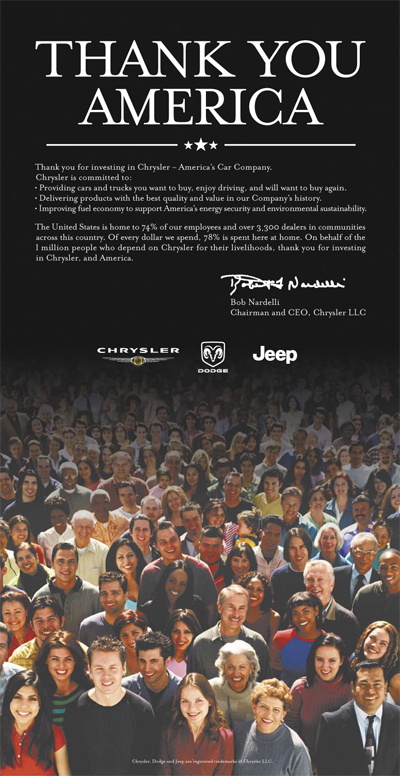
Thank You America! Bad Move Chrysler.

Chrysler received a $4 billion bailout from the U.S. Government. In my opinion, none of these bailouts were deserved, and it is the respective companies’ fault for having failed. But, I had no say in the matter. They got the bailout. We all know the story at this point. So, I won’t rant.

But, I saw this ad they put out a while back and had been meaning to share it with you all for a while now. They posted it on their blog, which welcomed a flood of thousands of hateful replies. The blog has since been deleted entirely. I don’t know if they actually bought any paid ad space and ran this (but if they did, the money spent on ad placement would be even more insulting).

But speculating aside, and ignoring the question of whether or not they deserved a bailout – do you think this “Thank You America” move was smart from a marketing or PR approach? If not, how do you think they should have handled it? Should they have acknowledged the bailout? Was there any good way to approach this?


Thanks for the Money!

Thanks for the Money!

Comments (3) »

Personal Branding. Brought to you by American Idol

They each have a distinct brand.

Idol contestants. They each have a distinct brand.

Guilty pleasure admission – I watch American Idol. There, I’ve got that out in the open. I feel better (with flashes of shame). But I’ve learned a few things by watching that show, other than how to hit that high C. American Idol gives us a couple of important lessons on personal branding.

The One Who…

When talking about American Idol contestants, we typically don’t remember their names, so we describe them in other ways: She’s the hippie girl; he’s the one that sounds like Sinatra; she’s the homeless girl; she’s the cute single mother; he’s the funny one. We’re defining the contestants by a certain set of characteristics – some physical, some behavioral. But, we are defining their brand. They are capturing a distinct position in our minds and hearts. This is a brand. How do people describe you when they talk about you? “He’s the one who is really focused on ROI, with a super-fun approach.” “She’s the mobile phone expert.” “She’s an over-bearing know-it-all.” 

And, you can’t have two cute, young, country singers. We only want one. You can’t have three hippie dudes. Our minds only want one brand to occupy that position. So it is with your personal brand. For example, you simply can’t be that guy who knows a lot about websites. Too many other people can occupy that same brand. Specialize the hell out of it. Be the guy who knows everything about SEO. Or even more, be the guy that knows everything about linking strategy for SEO. Or even better, be the guy who knows everything about SEO, and does instructional podcasts weekly, and always incorporates images of 80s TV stars. I don’t know – that’s a goofy example – but you occupy a clear brand position, at least. Be unique. Stand out. Just know that you will be described as something – what will it be? How will you be described?

Embracing Your Brand…

The other major lesson learned from American Idol is embracing your own brand. Ultimately, the contestants that succeed are the ones who decide who they are, and embrace it, whole-heartedly, in everything they do. You must embrace your brand. You simply cannot occupy more than one brand position. So, embrace what you are and pump it up. If you are the nerdy one – embrace that. If you are a bleeding heart, embrace that. Being true to your brand will ultimately be more powerful than trying to occupy a brand position that you could never own. Again – stand out and be unique. But don’t deny your brand – embrace it. 

And I’ll accept that the only place I’m a star singer is in my shower.

American Idol Cheerleaders

Comments (3) »